


Inhalt
Aktueller Ordner:
ARS_ExplainableAIreadme.md
ARS_ExplainableAI
Algorithmic Recursive Sequence Analysis for Explainable AI in Qualitative Social Research
---
🔑 Kernbotschaft / Core Message
> "Explainability is not a luxury – neither in AI nor in qualitative research."
>
> „Erklärbarkeit ist kein Luxus – weder in der KI noch in der qualitativen Forschung.“
---
📋 Overview (English)
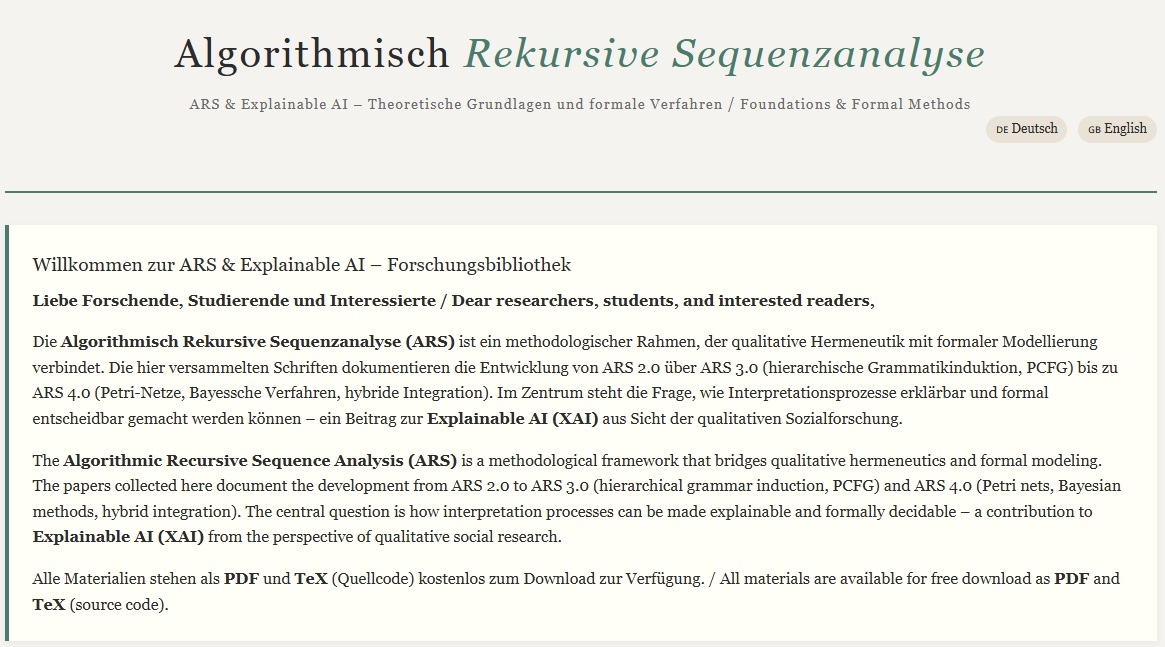
ARS_ExplainableAI is a methodological and software-based framework for Algorithmic Recursive Sequence Analysis (ARS). It integrates qualitative hermeneutics with formal modeling and contributes to Explainable Artificial Intelligence (XAI) in text analysis.
What problem does it solve?
Qualitative social research faces a methodological dilemma: Generative AI systems promise scalability but evade classical validation due to their opacity. ARS bridges this gap by making interpretation processes explicit, decidable, and reproducible.
This repository contains:
| Category | Content |
|----------|---------|
| Scientific Papers | Complete publications on ARS methodology (German / English) |
| Python Code | Grammar induction from terminal symbol sequences |
| Network Models | Transformation into Petri nets and Bayesian networks |
| Compression Principles | Repetition, recursion, symmetry, hierarchy |
| Optimization | Iterative adjustment of transition probabilities |
| Empirical Data | Eight transcripts of sales conversations (Aachen market, 1994) |
---
📋 Überblick (Deutsch)
ARS_ExplainableAI ist ein methodologisches und softwaretechnisches Framework zur Algorithmisch Rekursiven Sequenzanalyse (ARS). Es verbindet qualitative Hermeneutik mit formaler Modellierung und leistet einen Beitrag zur erklärbaren Künstlichen Intelligenz (XAI) in der Textanalyse.
Welches Problem wird gelöst?
Die qualitative Sozialforschung steht vor einem methodologischen Dilemma: Generative KI-Systeme versprechen Skalierung, entziehen sich jedoch aufgrund ihrer Opazität der klassischen Validierung. Die ARS überbrückt diese Lücke, indem sie Interpretationsprozesse explizit, entscheidbar und reproduzierbar macht.
Dieses Repository enthält:
| Kategorie | Inhalt |
|-----------|--------|
| Wissenschaftliche Aufsätze | Vollständige Publikationen zur ARS-Methodologie (Deutsch/Englisch) |
| Python-Code | Grammatikinduktion aus Terminalzeichenketten |
| Netzmodelle | Transformation in Petri-Netze und Bayessche Netze |
| Komprimierungsprinzipien | Wiederholung, Rekursion, Symmetrie, Hierarchie |
| Optimierung | Iterative Anpassung von Übergangswahrscheinlichkeiten |
| Empirische Daten | Acht Transkripte von Verkaufsgesprächen (Aachener Markt, 1994) |
---
🎯 Objectives (English)
Qualitative social research faces a methodological dilemma: Generative AI systems promise scalability but evade classical validation due to their opacity.
ARS_ExplainableAI addresses this challenge through:
- Transparent model construction – every interpretative step is explicitly documented
- Formalization of qualitative processes – transformation of interpretations into terminal symbol sequences
- Explainable network models – compressive transformation into Petri and Bayesian networks
- Recursive self-application – AI as an epistemic agent reflecting on its own interpretations
---
🎯 Zielsetzung (Deutsch)
Die qualitative Sozialforschung steht vor einem methodologischen Dilemma: Generative KI-Systeme versprechen Skalierung, entziehen sich jedoch aufgrund ihrer Opazität der klassischen Validierung.
ARS_ExplainableAI begegnet diesem Problem durch:
- Transparente Modellbildung – jeder Interpretationsschritt wird explizit dokumentiert
- Formalisierung qualitativer Prozesse – Überführung von Lesarten in Terminalzeichenketten
- Erklärbare Netzmodelle – komprimierende Transformation in Petri- und Bayessche Netze
- Rekursive Selbstanwendung – KI als epistemischer Akteur, der eigene Interpretationen reflektiert
---
📊 Methodological Transparency
> Note on Intercoder Reliability (1994 study):
> The original ARS study achieved a Cohen's Kappa of κ ≈ 0.55 – a value that highlights the limits of purely qualitative coding. ARS does not hide this weakness; it makes it the starting point of methodological reflection. Formal procedures make these limits visible and tractable.
---
🧩 How ARS Works (Mini Demo)
A sales conversation is transcribed and each speech act is assigned a terminal symbol:
KBG → VBG → KBBd → VBBd → KBA → VBA → KBBd → VBBd → KBA → VAA → KAA → VAV → KAV
| Symbol | Meaning |
|--------|---------|
| KBG | Customer greeting |
| VBG | Seller greeting |
| KBBd | Customer needs (concrete) |
| VBBd | Seller inquiry |
| KBA | Customer response |
| VBA | Seller reaction |
| KAA | Customer closing |
| VAA | Seller closing |
| KAV | Customer farewell |
| VAV | Seller farewell |
From this sequence, ARS induces a probabilistic context-free grammar (PCFG). Every decision is documented, traceable, and formally verifiable.
---
---
🚀 Getting Started
Prerequisites
- Python 3.8+
- Required packages:
numpy, scikit-learn, networkx, torch (for CL components)Installation
git clone https://github.com/pkoopongithub/ARS_ExplainableAI.git
cd ARS_ExplainableAI
pip install -r requirements.txt
Basic Usage
from src.grammar_inducer import GrammarInducer
Load empirical terminal chains
chains = [...] # Your sequences
Induce grammar
inducer = GrammarInducer()
compressed = inducer.induce_grammar(chains)
View induced rules
print(inducer.rules)
---
📚 Documentation
All scientific papers are available in
docs/ as PDF (print-ready) and TeX (source code). The TeX files allow full traceability and adaptation for your own research.| Document | Content | Language |
|----------|---------|----------|
|
ARS_XAI | Main framework: Between interpretation and computation | DE/EN ||
ARS_XAI_PCFG | Hierarchical grammar induction (ARS 3.0) | DE/EN ||
ARS_XAI_Petri | Concurrency modeling with Petri nets (ARS 4.0) | DE/EN ||
ARS_XAI_Bayes | HMM and dynamic Bayesian networks (ARS 4.0) | DE/EN ||
ARS_XAI_CL | Didactic exploration of Transformers, CRF, Attention | DE/EN ||
ARS_XAI_Hybrid | Complementary integration of CL methods | DE/EN |---
🤝 Contributing / Collaboration
This framework is methodologically mature but empirically underdetermined.
If you have access to larger datasets, are interested in methodological development, or want to apply ARS to new domains (doctor-patient interactions, classroom discourse, online conversations) – I warmly invite you to collaborate.
- Open Issues: Check the issue tracker
- Contact: post@paul-koop.org
---
📖 Citation
If you use ARS_ExplainableAI in your research, please cite:
@misc{koop2024ars,
author = {Koop, Paul},
title = {Algorithmic Recursive Sequence Analysis (ARS) as a Framework for Explainable AI},
year = {2024/2026},
url = {https://the-last-freedom.org/algorithmisch-rekursive-sequenzanalyse/ARS_ExplainableAI/},
note = {Open access: PDF and TeX available}
}
---
📄 License
Creative Commons BY-NC-SA 4.0 – Free use for non‑commercial research and education with attribution and share‑alike.
---
🔗 Links
| Platform | Link |
|----------|------|
| 🌐 Project Website | arsxai.org |
| 🐙 GitHub | pkoopongithub/ARS_ExplainableAI |
| 🦊 GitLab | pkoop/algorithmisch-rekursive-sequenzanalyse |
| 📄 OverLeaf | Read-only project |
---
📅 Historical Note
The empirical foundation of this project consists of eight transcripts of sales conversations recorded at Aachen market square in June/July 1994. The original coding sheets with handwritten codings by two independent coders are included in
docs/fallstruktur.pdf. This historical material serves as a transparent basis for reliability calculations (κ ≈ 0.55) and methodological reflection.---
„Explainability is not a luxury – neither in AI nor in qualitative research.“